

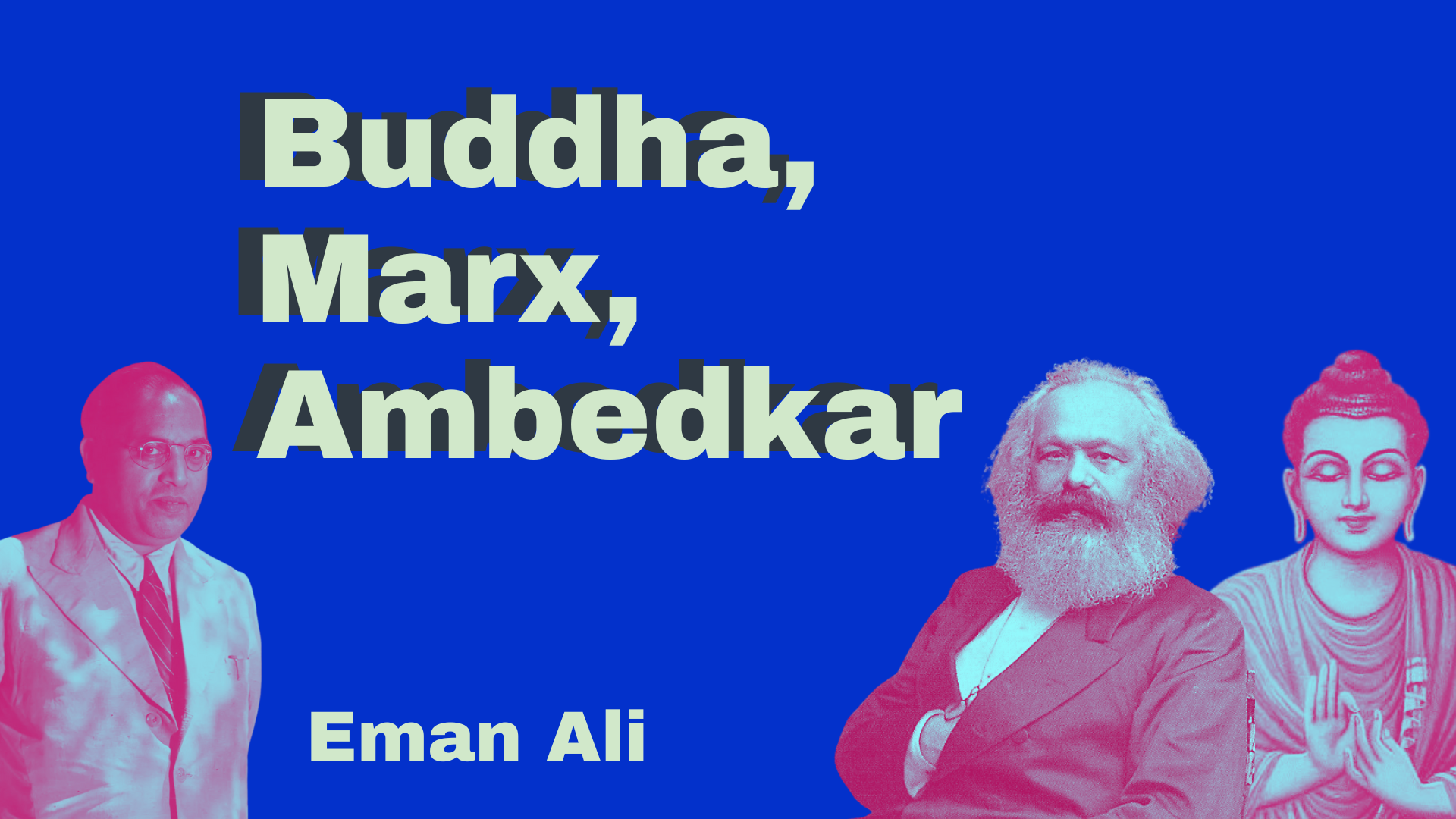
An excerpt from Eman’s thesis: Buddhism, Marxism & Dalit Activism in Dr. Ambedkar’s Buddha or Karl Marx.
The use of force heavily informs Ambedkar’s interpretations of both Buddhism and Marxism in Buddha or Karl Marx. He seems to contemplate the efficacy of force in creating change, appropriate situations for the use of force, and what will occur when force is withdrawn. In his interpretation of Buddhism, energy should be directed towards a clear purpose as opposed to violence, which does not have a purpose besides inflicting harm. Thus, one must be mindful of how they manifest and direct their force, mitigating as much harm to anyone as possible. The determination of a justified act of violence is vague; one must be mindful of whether their action contributes to an end that furthers “truth and justice.” Nevertheless, this mindfulness of force is one of the aspects of Buddhism which makes it supersede Communist means according to Ambedkar.
His critique of Communists echoes a similar sentiment; unnecessarily killing private property owners in the process of achieving their ultimate end of communism exemplifies unmindful exertion of force. This violence is not inherent to the Marxist Creed, yet these Communists used violence anyway. In his interpretation of Marxism, he also urges readers to consider the ways in which they themselves perpetuate violence whether they are cognizant of it or not – perhaps a direct jab at those who ascribe to their jati yet deny their participation in the structural violence of the caste system. Thus, people must become self-aware of their contribution to casteism before they become willing to accept any reform. Since caste discrimination is a deeply ingrained social mentality, it cannot be changed with violent force. Caste mentality must transform before reform is introduced because change cannot rise from external pressures, according to Ambedkar.
The unifying characteristic of Ambedkar’s contemplations on force is mindfulness of purpose; from his justification of purposeful force under dictatorship and distinction between force and violence, Ambedkar urges readers and followers to act with intention. He wants his followers to pay attention to how their actions impact themselves, other people, and broader institutions at hand. The propagation of such mindfulness pervades his activism as well. In a 1929 publication of Bahishkrut Bharat called “First Superstructure, Then Base,” Ambedkar warns his followers to be careful about when and how they strike because “those who were responsible for feeding their families did not want the strike at this time, at all….it was impossible for them to carry on the strike for too many days…the development of workers’ movements into unnecessary starvation and indebtedness were not desirable to us.” Instead of insinuating violence, Ambedkar insisted that people of lower castes “acquire new skills and stat new professions…. [and] education would enable them to get employment…[because] there was no point in remaining dependent on village economy.” By decreasing their dependence on caste Hindus, untouchables could empower themselves while undermining the bondage of the caste system. This publication demonstrates that Ambedkar has consistently thought about mindfulness of action, which entails taking precautions not to needlessly harm oneself or others in achieving the end of communism.
Ambedkar’s exhaustive reflection on force is one manifestation of his desire to change people’s minds and disposition so that they voluntarily demonstrate ideal behavior without force. Transforming collective conscience must be achieved through thoughtful intentional actions as opposed to demonstrations of outrage. One of the core messages of Buddha or Karl Marx is that the Buddha’s method is superior to that of communism because reform is attained without force or compulsion. Ambedkar’s understanding of maitri, khanti, and metta lends to an interpretation of caste discrimination as a social psychology of Hinduism as opposed to hatred and his construction of ahimsa frames social conscience transformation as an act of compassion. Ambedkar critiques Communist means of implementing a proletarian dictatorship using force because their ideology cannot be sustained after force is withdrawn, and thus must be supplemented by religion. His interpretations of these Buddhist concepts align with his critique of Communist means in that they promulgate the need for gradual and non-violent reform.
To Ambedkar, internal reform is about gradually shifting mindsets as opposed to ‘instant revolution’ or imprudent exhibitions of frustration through violence. Ambedkar has maintained this sentiment since his early journal publications. In a 1929 publication of Bahishkrut Bharat called “First Superstructure, Then Base,” Ambedkar critiques strikes for increasing the “feeling of dissatisfaction among the workers” in order to prepare for an instant revolution, which is “neither possible nor desirable.” Frustration is essential for a revolution, yet not productive in priming minds for change. Instead of striking, Ambedkar urges readers to “contemplate on how prepared are the minds of the workers of the country for a revolution.” Furthermore, as Ambedkar’s activism matured, he organized fewer satyagrahas or occupations and shifted more towards an education-based approach of giving speeches and publishing work. Once again, Ambedkar’s interpretations in Buddha or Karl Marx and his actions exhibit an implicit concern with changing social conscience through external force without religion, which stimulates the internalization of new ideologies. Undirected exhibitions of anger and violence do not work towards this end.
Ambedkar’s preoccupation with the idea of dictatorship is closely related to his ruminations about force versus actions as well. He holds a bitter-sweet relationship with dictatorship; his reluctance to fully embrace it is not surprising given his demonstrated loyalty to democracy. He supports dictatorship only to the extent that it serves as a means to establish a democracy. Since Ambedkar firmly believes in establishing a social democracy before a political one, dictatorship functions to transform the moral conscience to prepare it for democracy and will dissipate on its own once it has served its purpose. However, Ambedkar’s consideration of dictatorship as a potential means for reform is the most baffling feature of Buddha or Karl Marx. It contradicts his previous expression of distrust towards institutions as channels for reform, emphasis on internal change as opposed to external change, and Buddha’s opposition to dictatorship.
Perhaps Ambedkar utilized the word ‘dictatorship’ in a much more comprehensive sense of the term that is not cognizable at first glance. In Buddha or Karl Marx, the work of an effective dictatorship is to remove “all the obstacles and boulders in the way of democracy and has made the path of democracy safe.” It is one that looks different from the Communists’ permanent dictatorship of the proletariat. By analyzing Ambedkar’s idea of ‘dictatorship’ in his interpretations of Buddhism, it is possible that Ambedkar’s suggestion for a short-term dictatorship in his discussions of communism seems to be one facet of a broader narrative — one which conceives of some form of centralized authority as key in creating successful reform towards democracy. Ambedkar’s emphasis on the person of the Buddha, who sets an example of virtuosity for all other humans through a non-forceful method of preaching, also fits into this meta-narrative of authority. The Buddha is representative of the centralization, which Ambedkar sees as essential to reform; adopting ideal behavior and values can be achieved by simply paying heed to the character of the Buddha, who serves as the centralizing figure. Thus, Ambedkar’s discussion of dictatorship may not necessarily equate to advocating for a Russian-like dictatorship, but rather some form of centralizing entity as the conduit for democratic reform. Furthermore, the concept of centralized authority informs both Ambedkar’s interpretations of Buddhism and Marxism and yet adopts different forms in each interpretation.
Another interpretation of Ambedkar’s ‘dictatorship’ is that organizing mass conversions was Ambedkar’s way of harnessing the efficacy of centralized authority while maintaining his belief that change in behavior must be voluntary as opposed to externally forced. He characterized social democracy as the “absence of stratification of society into classes” and “a social habit on the part of individuals and groups which is ready for continuous readjustment or recognition of reciprocity of interests.” Conversion to Buddhism is a step towards cultivating the social habit which is required for social democracy.
Although abidance to religion is not explicitly ‘dictatorship,’ constant reminder of the teachings and actions of a religious authority figure such as Buddha does govern an individual’s behavior to a great degree. As opposed to a demanding external authority figure, religion transposes centralized authority within the individual and thus urges them to exhibit certain behavior voluntarily. \Thus, mass Buddhist conversions were perhaps the best way in which Ambedkar could catalyze the internalization of socially democratic values without a formal dictatorship; conversions imbue each individual with deep veneration for Buddha. It is compelling that a synthesis of Ambedkar’s interpretations of Buddhism and Marxism illuminates and clarifies his stance on dictatorship.
This interpretation of Ambedkar’s ‘dictatorship’ is compatible with pre-existing hypotheses on the motivations behind mass conversion to a large extent. Audi suggests that Ambedkar “revived the issue of conversion in 1956 because the ‘benefits’ given by the Indian Constitution to the untouchables failed to satisfy him.” Gokhale proposed that the Nagpur Mass Conversion was an “ambitious attempt to construct a new ideology fundamentally opposed to the traditional Hindu system of beliefs… to transform the consciousness, both individual and collective of the Mahar-Buddhists.” Others like Stroud acknowledge the influence of the “Deweyan ethos of religious rhetoric as an emancipatory decide for individuals and communities” in Ambedkar’s decision to lead a mass conversion. The interpretation of ‘dictatorship’ as the internalization of the Buddha’s dhamma does not contradict these viewpoints. In fact, this interpretation enhances these postulations by examining how conversion could effectively overcome the failure of the Constitution, transform consciousness through new ideology, or emancipate individuals and communities.
It has been established that Ambedkar’s interpretations of Buddhism and Marxism in Buddha or Karl Marx are heavily influenced by the motives of his Dalit movement. The following issues are recurring themes that appear in both his interpretations of Buddhism and Marxism: purposeful and mindful use of force, changing man’s dispositions without force, and dictatorship to establish social democracy. Mindful use of force in provoking reform takes into account everyone’s well-being, including one’s own. It takes the form of changing mentalities as opposed to finding outlets for frustration. This transformation of social conscience and social habit must be achieved without force, and thus entails gradual slow change as opposed to instant revolution.
It is not surprising that Ambedkar’s rubric for evaluating Buddhism and Marxism is focused on force to a great extent. Since Buddha or Karl Marx was written towards the end of his career as a reformist, it is plausible that Ambedkar was conjecturing how much force is necessary to elicit social change because he was not able to accomplish what he wished to in his lifetime. According to Buddha or Karl Marx, religion and conversion were the answers to his meditations on force; they were the answers to his ruminations on how to effectively catalyze social reform in India. It is peculiar that Ambedkar waited approximately twenty-one years to execute his conversion. He announced his intention to abandon Hinduism in a speech given in 1935 and finally converted in 1956. Viswanathan theorizes that these twenty-one years were a preparatory period that was “less a period of uncertainty or hesitation than a careful working out of alternative possibilities for Dalit emancipation.” According to Audi, the ‘alternative possibilities’ that Viswanathan addresses, namely constitutional means, proved inadequate for Ambedkar. Thus, it is conceivable that force was at the forefront of Ambedkar’s mind in 1956 because the alternative possibilities for emancipation had not worked out as well as he had hoped.
Although one can understand how Ambedkar saw religious conversion as the answer to his contemplations on force, it is troublesome how conversion distributes the weight of reform onto the Dalit masses. In his 1956 speech to Dalit Converts in Nagpur “Why Nagpur?”, Ambedkar tells his followers that their responsibility is great to correctly observe Buddhism in order to “save ourselves, we save our country – and not only that, but the world also.” In light of Ambedkar’s emphasis on the hierarchical oppressive nature of the Brahmanical caste system as a whole entity, how exactly are Dalits expected to save themselves and the world as well? Ambedkar’s commentary on force between the lines of Buddha and Karl Marx helps illuminate how he envisions Dalits catalyzing this process of change.
Given that caste is a deeply embedded social psychology that relies on hierarchical designations of power, caste mentality has been internalized by lower castes as well. Thus, Dalits must represent themselves in a more empowered manner by uplifting themselves in order to change the dispositions of others. In order for others to see them as anything more than Untouchables, they must first see themselves in such a regard. In his 1936 speech “What Path to Salvation,” Ambedkar says he fails to “understand how [you can] achieve progress so long as you have the stigma of being an Untouchable.” Conversion to Buddhism opened up a slightly wider range of economic and social opportunities while simultaneously empowering Dalits to take these opportunities. Thus, conversion helps eliminate caste mentalities in those most afflicted by it.
Furthermore, it must be reiterated that the power of the upper castes relies on its positionality in relation to lower castes. As Ambedkar has posited, there is no ‘caste,’ but only ‘castes.’ In other words, the identity of the upper castes fundamentally relies on the existence of lower castes. Through conversions, the legitimacy of identity is essentially undermined. However, mass conversion is most likely the first stepping stone towards Ambedkar’s goal to eliminate the caste system as opposed to an end in itself. The momentous effect of conversions on the upper castes has yet to be seen. By comparing Ambedkar’s interpretations of Buddhism and Marxism, one can extrapolate his powerful insights about the use of force to further comprehend why he turned to mass conversion as a tool for reform. His work forces us to wonder how much physical force is really required to create mental transformation. Through harnessing the zeal of religious devotion in India to transform individual and collective consciousness, Ambedkar forged a middle path between forceful dictatorship and constitutionalism.