

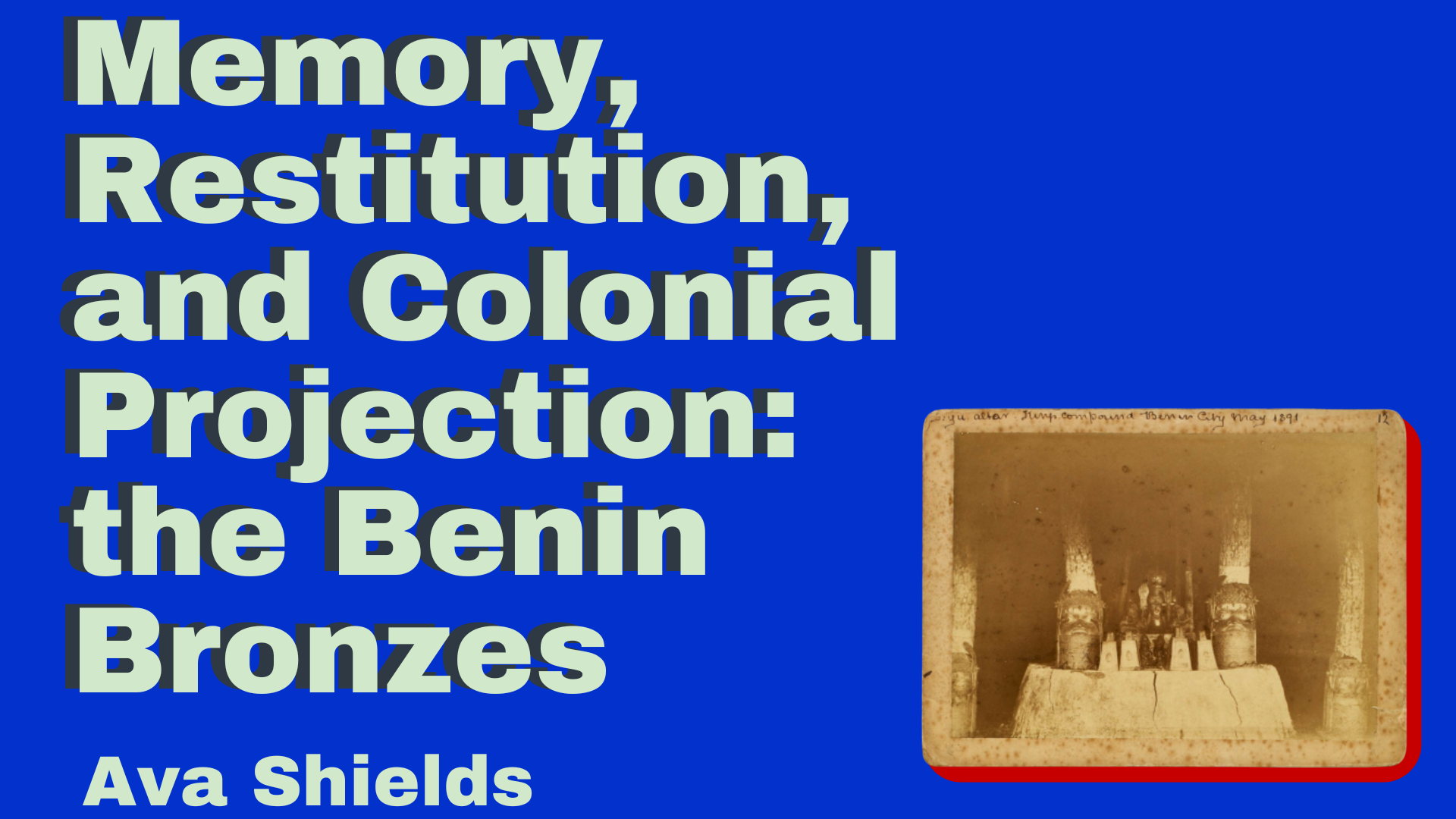
An excerpt from Ava’s thesis: Memory, Restitution, and Colonial Projection: Past and Future of the Benin Bronzes. Footnotes not included.
Fig. 1. Photograph of an ancestral shrine at the Palace, Benin City, taken during the visit of Cyril Punch in 1891. Eliot Elisofon Photographic Archives, National Museum of African Art, Smithsonian Institution. EEPA 1993-014.
Despite ample writings, curatorial decisions, and changes in academic structure we have most encouragingly seen in the last twenty years, the shockwaves of art history’s colonial past reverberate still. Sometimes they are blatant: overt racism in the field, the exclusivity and whiteness of the art institution, the persistent inequities in access, representation, and recognition. Sometimes they ripple quietly, more sinister in their anonymity, creeping through art spaces like a deadly fog. Reconciling these realities brings into question the structure of the entire field. How do we account for the anti-Blackness and dispossession of the global south that this field promotes, profits off, and relies upon? How do we in turn reconstruct, repopulate, or disassemble our institutions without sanitizing the inherent violence of the field, which should never be erased? Dan Hicks, head Curator at Oxford’s Pitt Rivers Museum, puts it plainly: How do we decolonize in such a way that does not result in the cancellation of outstanding debt? Our task is not to conceal these colonial inheritances but to acknowledge them fully, pursue meaningful reconciliation, and actively forge a more equitable future for art history. In order to realize our visions for the future, art professionals must first acknowledge and name what is wrong in the field. We cannot build a beautiful structure on a rotten foundation, and we cannot simply cover the decay. We must excavate the rot, clear the ground, and build anew.
Art is a human concept, and the galleries, museums, and educational structures we build around it are equally so. These institutions absorb the values and dynamics of the societies that create them. Art does not operate in an objective vacuum: it moves, behaves, and is motivated in a deeply human way. In this sense, art also has a profound capacity to produce harm and perpetuate cycles of injustice. We are taught that art is elite, intellectual, refined; that the museum is a site of learning, bettering, and becoming sophisticated. Art — and its various forms — can function as covert methods of truth‑making.
The question of ownership connects art’s colonial past to the contemporary political environment, with the possession of stolen cultural material becoming a more and more prevalent topic day by day. This paper will investigate perhaps the most notorious of such cases, that of the Benin Bronzes, which were looted by colonial British forces in 1897. Because of their wide publicity and the brutality of their seizure, they are a perfect launching point for discussing the larger and infinitely more complex problem of post-colonial accountability, heritage, and debt.
The Edo Kingdom was a transformed descendant of late Iron Age urban centers of the 10th and 11th century, and has been ruled by an unbroken line of Obas (kings) since Ewuare I, who reigned from 1440 CE. It was a notoriously rich and influential kingdom, renowned for its skilled artisans and sophisticated metallurgy. The royal court of Benin was home to a massive collection of sacred artworks colloquially known as “The Benin Bronzes.” The collection documented centuries of the kingdom's history, changing religious observances, and royal bloodlines. They are symbols of sovereignty, power, and independence.
The charismatic and irascible Oba Ovonramwen Nogbaisi of Benin was immediately identified as an obstacle to British intervention. Consul-General Claude MacDonald of the Oil Rivers Protectorate noted ongoing issues with the Oba of Benin in a letter to British Prime Minister Salisbury:
There is no doubt that the Benin Territory is a very rich and most important one…Trade, commerce and civilisation however are paralysed by the form of Fetish Government which unfortunately prevails throughout the Kingdom... I shall be surprised however if these barbarous practices which have been the custom of the country for centuries will be abandoned by the Priesthood without a severe struggle, and a display, and probably use of force on the part of the Government of the Oil Rivers Protectorate.
Consul-General of the Niger Coast Protectorate James Phillips also wrote to Prime Minister Salisbury about the restrictions of trade:
I am certain that there is only one remedy, that is to depose the King of Benin from his Stool... I therefore ask for his Lordship’s permission to visit Benin City in February next, to depose and remove the King of Benin and to establish a native [British] council in his place.
It didn’t take long for these schemes to come to fruition. The lie of the Benin Bronzes usually begins with the Phillips Expedition of January 1897. According to the myth: while en route to a negotiation with the Oba regarding trade, the Consul-General of the Niger Delta Protectorate, James Phillips, and his party, were ambushed. Upon setting out from Gwato, the traditional launching point for British Campaigns traveling to Benin City, Phillips received a direct warning from Chief Dore Numa, the royal correspondent on Ikpoba Creek, that any white man seeking to come to the City would be killed. Phillips continued upriver, and when Itsekeri trading chiefs saw the party from the banks of the Niger and guessed at their intent, they quickly informed the Oba of Benin that “the white man is bringing war.” Phillips and his party were ambushed near the village of Ugbine. Two Europeans survived the attack. No official record was taken of the death toll of the African porters, translators, or soldiers accompanying them, though initial press reports stated that at least 250 were killed. British media outlets frequently ran campaigns castigating the violence and barbarity of the Edo Kingdom and its ‘fetish’ ruler, an excerpt from The Graphic on January 16, 1897, reads:
TRULY may Africa be called ‘the White Man’s Grave.’ Before the echoes of fatal fighting have died away in the East and South, the disaster on the West Coast opens a fresh chapter of native treachery and loss of life. A peaceful British mission from the Niger Coast Protectorate, travelling up country to negotiate with the King of Benin, have been treacherously attacked, and, so far as known at present, massacred to a man.
Although the expedition is described here as peaceful, in reality, Phillips was accompanied by a unit of armed soldiers in disguise. The Graphic’s noble narrative is rather inconvenienced by the wealth of correspondences, spanning years before the Phillips Expedition, which discuss the potential annexation of the Kingdom of Benin.
Two years before the Phillips incident (in the spring of 1895), the Oil Rivers Protectorate sought approval to attack Benin City from the Crown Colonial Office, but the request was denied. In the interceding years, “an elaborate survey of the rivers and waterways leading into the Benin territory” was undertaken by both Protectorate and the Royal Niger Company, according to the Scotsman. Vice Consul of the Cameroons and Oil Rivers Protectorate Harry Johnston recalled that “When [I] arrived at the Niger Delta in 1885 and took stock of the situation I decided there were two powerful native states with whom one had to deal carefully: the Kingdom of Benin on the west, with its important coast vice-royalty under the chief Nana; and Opobo, under Jaja, to the east of the main river.” The two chiefs to whom Johnston refers were found guilty of fabricated crimes and punished in the following years. ‘Jaja,’ or King Jubo Jobogha of Opobo, was kidnapped, falsely tried, and exiled in 1887. Chief Nana of Brohemie was captured, convicted of ‘horrible acts,’ and exiled in 1894.
Vice Consul Galway’s Report on Benin District of Oil Rivers Protectorate for the year ending 31 July 1892 complained about the Oba’s frequent and irksome trade restrictions, and looked to the future of the region: “The breaking down of this fetish theocracy must take time, and can only be effected by degrees. Anything in the shape of a punitory expedition, though it may eventually prove advisable, would paralyze trade for a very long period.” In 1893, MacDonald expressed similar sentiments, saying “Time and much patience will be required however before the resources of this district can be in any measure developed, the great stumbling-block to any immediate advance being the fetish reign of terror which exists throughout the Kingdom of Benin, and will require severe measures in the future before it can be stopped.”
These damning correspondences call into question the ‘peaceful trade party’ led by Phillips in the winter of 1897. The two British survivors of the attack, Alan Boisragon and Ralph Locke, appealed to British parliament later that month, requesting a military force with which to inflict punishment on the Kingdom of Benin. The Sacking of Benin (also called the Rape of Benin) was thus labeled the ‘Punitive’ Expedition. Contrary, however, to the media campaigns of British tabloids, the Rape of Benin City was no retaliatory act. It was premeditated and specifically designed to overthrow the Oba of Benin for his restrictions on British trade along the Niger River.
Thus begins the legend of Benin: unprompted, violent attack, and punitive, deserved retaliation; but the sheer scale and tactical force of the attack indicates that “an operation of this scale could not have been planned and delivered between mid-January and mid-February 1897.” The expedition held three attack columns, comprising around 5000 Europeans and an assortment of mercenaries from Sierra Leone, Lagos, and surrounding areas. While one naval battalion sailed along Gwato Creek to the west of Benin City, a second traversed the Jamieson River, landing east of Benin at Sapobar. The main attack column marched north-west to Benin City from Warrigi. The commanding orders to the eastern and western columns were to “harass and destroy towns and villages while the main operations lasted, and so increase the punishment inflicted on the nation.”
The cities along either route were razed completely, and the city of Benin was obliterated. Sacred and domestic buildings were burned to the ground as those inside perished. The soldiers raped, beat, and otherwise humiliated the adult women, while suspected virgins were covered in boiling tar. Children were decapitated, sacred trees vandalized, and exploding gunshells lit fires everywhere. The cities of Ologbo, Egoru, Sapoba, Gill-Gilli, Gwato, and dozens of other small trading settlements were destroyed. 33 The Oba of Benin was captured and exiled, and the kingdom officially fell under British control.
An enduring misconception about the theft of the Benin Bronzes is that they were taken in a moral effort to preserve cultural heritage, or to safeguard history. This rhetoric is maintained by the British Museum today. Yet there is sufficient evidence that, along with a desire to doubly humiliate the Kingdom of Benin through looting, one main motivation for the theft of the collection was to pay retroactively for the massively expensive Phillips Expedition. According to Thomas Obinyan, Phillips claimed in his 1896 request to the Colonial Office that the cost of the invasion would be recovered by the massive stores of ivories and treasures in the Royal Palace. Says Bill Fagg from the British Museum,
The bronze plaques, between 900 and 1000, were reported by cable to the Lords Commissioners of the Admiralty by Admiral Rawson and became the official booty of the Expedition to be sold to defray the cost of the pensions of the killed and wounded. The remainder – bronzes, ivories, wood carvings and iron work, were not reported but shared out carefully among the officers.
Numerous photographs were also taken of the stolen loot on sight in Benin City, often with the soldiers of the British army posing boldly (Fig 2). The reproduction of this moment through the technology of photography is a continuation of the initial violence, as is the continual display of both the objects and the images. Through the ongoing public display of both the objects and the photographs, the violence of the original looting is repeatedly normalized — the museum becomes not merely a repository but a stage that sustains colonial pain under the guise of heritage.
Recently, several European governments have established formal plans to loan pieces of their Benin collections to the state of Nigeria. German, French, and Scottish officials have long been in contact with the Benin Dialogue Group, an organization with representatives from the Edo state government, the Royal Court of Benin, and museum directors and delegates from various European countries. The partial return of these pieces is, in many cases, reliant on the construction of the new Edo Museum of West African Art in Benin City. Proposals have been made for a rotating exhibition, wherein parts of foreign collections could be shipped back and forth to Nigeria to be displayed in different parts of the world. As recently as April 30, 2021, the Federal Foreign Office of Germany released a joint statement with the BDG, establishing these “Concrete Steps” with regard to the repatriation of the Benin collections held in several major German museums:
1. Create extensive transparency with regard to the Benin Bronzes in their collections and exhibitions;
2. Hold further coordinated talks on returns and future cooperation with the Nigerian side at an early date; in this context, one aim will be to reach an understanding with the Nigerian partners on how Benin Bronzes can continue to be shown in Germany;
3. Determine concrete actions and a timetable for the upcoming talks.
Certainly these affirmations are encouraging, and show progress along the path of repatriation. In the UK, some local museums have broken rank with the British Government and made similar promises. On March 26, 2021, the University of Aberdeen confirmed its plans to repatriate a bust of the Oba of Benin, obtained in the 1950s. National British museums, however, are barred from returning their collections by the British Museum Act of 1863 and the Heritage Act of 1983. These acts are in line with Britain’s retain and explain model, which asserts the right to keep historical artifacts, but expresses the need to provide context for the objects. Oliver Dowden, Secretary of State for Digital Culture, Media and Sport of the United Kingdom, spoke vehemently against “the removal of statues or other similar artefacts,” and encouraged the British Museum to “defend our culture and history from the noisy minority of activists constantly trying to do Britain down.” He continues, “Our aim should be to use them to educate people about all aspects of Britain’s complex past, both good and bad.” But this sentiment smells strongly of Euro-centrism. It is difficult to believe that the remembrance of Britain’s past should be in question when discussing a group of Edo sculptures dating back to the thirteenth century.
Repatriating the Benin Bronzes is more than a symbolic gesture or moral correction; it is a relinquishment of the colonial narrative. True repatriation requires acknowledging the horrors of colonialism. Returning these objects also means surrendering the cultural capital that has long been used to assert ownership over history. Western institutions, long acting as self‑appointed custodians of global heritage, must cease profiting from looted property, whether through tourism, prestige, or grant‑funding.
Foreign museums and collectors often focus only on material conservancy, neglecting what Moira Simpson calls the “intangible aspects of heritage.” When looted objects are returned to their indigenous or post-colonial homes they may stimulate cultural maintenance, providing or obtaining new meanings to those intangible aspects of heritage and promoting the transmission of intergenerational knowledge within those communities. Many indigenous communities around the world have instituted preservation practices which combine western conservation methods with ceremonial upkeep of said objects' spiritual value. Says Simpson, “For some communities the repatriation of ceremonial materials from museums may be an important part of this process and linked to strategies to aid recovery from postcolonial trauma, and, as such, it has the capacity to contribute to indigenous health and well-being. The return of sacred artifacts, art objects, and ancestral remains can have incredible effects on the health of indigenous and post-colonial peoples. A 1998 study at the University of British Columbia identified “cultural discontinuity as a primary factor in suicide among both young people and adults in First Nations communities in British Columbia; this, [we] believe, is the reason why some communities show rates 800 times higher than the national average.” The transference of intergenerational knowledge, the reminder of the customs which existed prior to colonization, and the evidence of the physical history of a people are critical to the health of a society. Kalpana Nand, Education Officer of the Fiji Museum, states: “Culture is a living, dynamic, ever-changing and yet ever-constant thing – it is a story, a song, a dance performance, never a ‘dead thing’ to be represented in the form of an artefact to be looked at through glass.”
In the Edo language Bini, the word sa-e-y-ama means ‘to cast a motif in bronze.’ But it also means ‘to remember.’ Physical objects constitute an important part of collective memory, they are forensic evidence of a past. When we curate, display, and document these objects, we assert control over historical narratives. Our interaction with physical objects, therefore, is also an interaction with memory. Looting, at first, might seem like a singular crime–a theft, with a singular penance: restitution. But in reality, looting involves a multiplicity of both physical and psychocultural crimes which repeat themselves long after the seizure. The loss is a continued event, perpetuated by the museum, the collector, or the university; while the gain is enjoyed most enthusiastically by the historian, the curator, the artist, the student, the museumgoer. The methods of stilling we use in the museum: the glass display case, the photographic negative, the vague placard inscribed with a date of acquisition, must be understood as extensions of imperial violence, weapons for creating a timeless past in the present. The museum with all its purported neutrality must recognize its participation in ongoing systems of epistemic violence. Like the duality of looting, like the gun that shoots twice, our response to our colonial past must involve both the return of the looted items and the restoration of stolen memories. Repatriation must be joined by an open and frank recognition of the historical violence that the Western art world continues to feed today.