

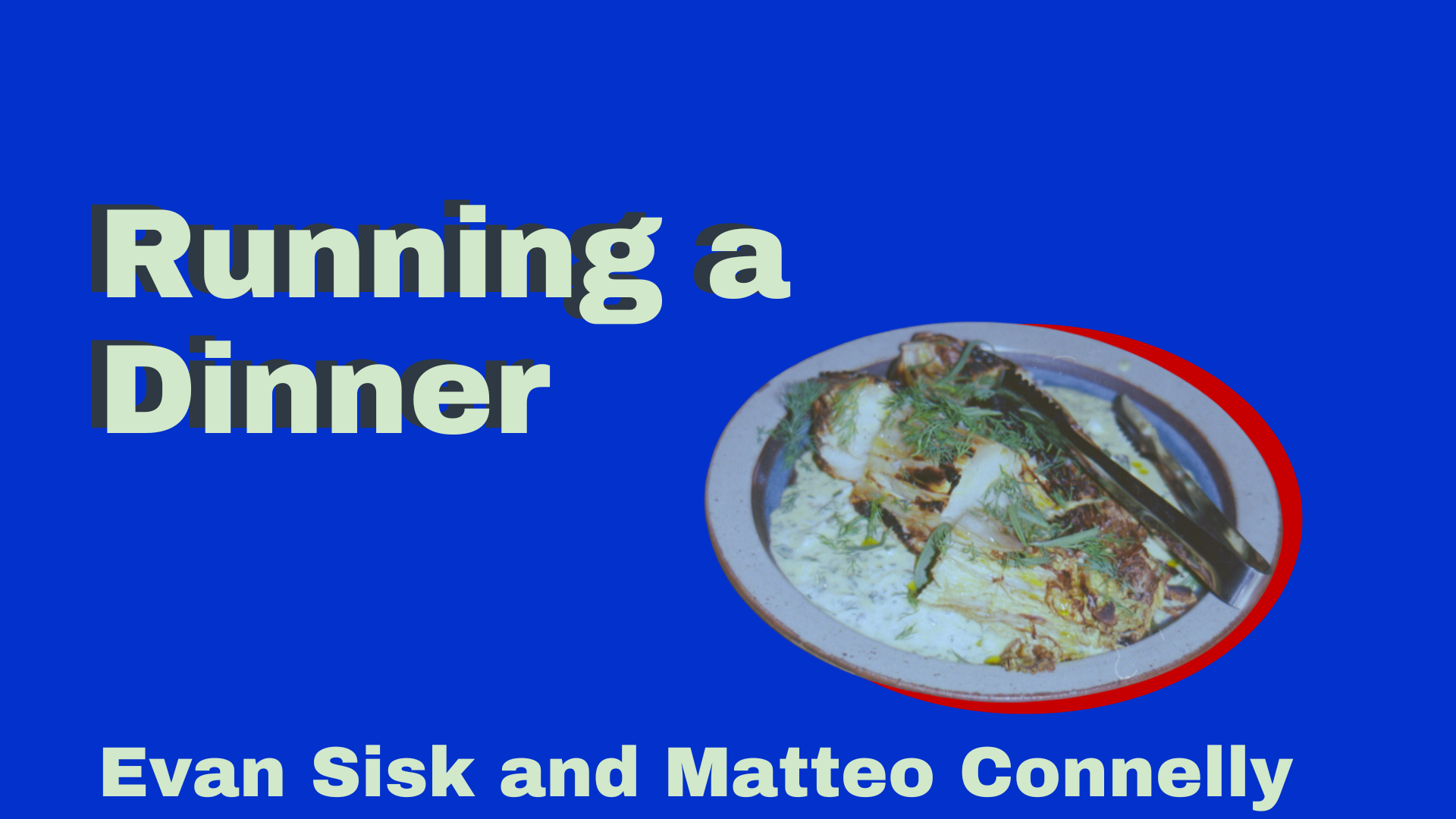
Every chef, at one point or another, has a dream of running their own restaurant. Some may dream of making food that wouldn’t look out of place in the Louvre sitting next to a Picasso or a Monet. Some may have more humble ambitions of making food for the soul, unfussy and approachable dishes for the people in their community. Others sit somewhere in between, and this is where myself and my chef partner Matteo find ourselves. We’re two professional cooks with a mutual love of the craft, a little bit of talent and a desire to find our creative voices in a medium which oftentimes, in order to gain experience, requires you to painstakingly execute the vision of somebody else.
We ended up tossing around the idea of doing a “pop-up dinner”, a somewhat new concept among the old world of restaurant dynasties and celebrity chefs. Amidst the backdrop of an America where wages are stagnating, costs for are rising, and the restaurant industry is struggling, pop-up dinners are an exciting and community-based medium for chefs. Pop-up dinners have allowed a new wave of inspired and motivated young cooks who’ve spent years in the all consuming grind of the traditional restaurant world to hone their craft and get a taste of running their own kitchen.Inspired by the local taquero on the corner and the dosa man in the park, they take matters into their own hands and do a full service meal in their own apartments or the apartments of others, on the street corner, or by taking over someone else’s restaurant for one or multiple nights, bringing their vision of what good food is, to fruition without the burden of investors or of having to make the food that makes the most money.
So, there Matteo and I were, trying to figure out what our vision of a makeshift dinner would look like. Our combined cooking experience ranged widely from various Asian, European and Levantine cuisines, so we decided on a mish mash menu of different flavors and techniques that would showcase pieces of all of those respective styles. A Japanese style presentation of delicately prepared scallop crudo wrapped in shiso leaf preceding a main course of a heavy, unctuous presentation of Portuguese piri piri chicken? Sure, why not? After all, it was our menu and we got to decide.
Soon, the menu was set, around twenty or so guests had been invited, and we had spent days prepping everything that we’d need, figuring out final plating and what dishes would go with which. The day had finally come and we headed into it feeling confident with a tinge of anxious anticipation, naively hoping that everything would go according to plan. Being a cook and running a service, whether in a restaurant or elsewhere, you become intimately familiar with thinking on your feet and managing unforeseen circumstances that might occur. We enlisted the help of many friends to make sure that the night would run smoothly. Our line up included Ryan, who would be our main server/food runner, Reuben, who would assist Ryan in the front of house and Kiyoshi, our friend and a supremely talented pastry chef who made the night's dessert and who would become our rock in the chaos.
The chaos started with Matteo and I picking up the oysters for the initial raw course, trying one and subsequently having a mutual panic attack that we’d received a case of bad oysters and that we were both going to die after consuming them. We came to find out that what we suspected to be spoilage, was in fact a sign that the oysters were in mating season and that we were totally fine — the more you know. Crisis number one averted. Everything was set and guests were going to be arriving soon. In an attempt to make Matteo’s backyard a suitable dining area, we bought string lights to make sure there would be sufficient lighting for our guests. No matter what we tried, we couldn’t get them to hang up correctly. After breaking about 6 of the glass bulbs and cleaning up their remains, we had finally gotten them precariously wrapped around two trees. Crisis number two averted. Time turned out to be our biggest opponent that night, which isn’t uncommon in food service, and as the guests began to arrive, we realized that only one of us would have the hands to shuck and plate the seventy five oysters that we wanted to serve. So in an attempt to distract from how long the oysters were taking, we served as much alcohol as we could and encouraged the guests to mingle. We got the oysters out, but with twenty five less than we initially wanted, still amounting to two or more per person. Crisis number three averted.
After the first course and some mingling of our own, it was go time. We flipped on the burners and began cooking. The initial courses flew out without a hitch and we were feeling like everything was going smooth. This was until we realized that the cara cara oranges we’d gotten for the salad course all contained seeds which we had to meticulously pick out one by one. More time lost and another crisis averted, but we were still feeling like we were well on track and everyone seemed to be having a good time. The next courses came out smoothly, with Ryan running the food and drinks and doing what he does best by making sure that everyone had what they needed. We had finally reached the main course, which involved cooking about fifteen half chickens over charcoal in two little Weber grills. In a rush to set them up I had put far too much charcoal thus making the grills wildly hot, burning whatever we put on it in no time. At about hour three of the dinner we did some more improvising by having a drinks course in which Kiyoshi created a beautiful impromptu cocktail. Meanwhile, I’m panicking while trying to figure out how to get the final course out. Matteo and I tried everything we could possibly think of in our stress induced delirium to solve the problem, when Kiyoshi pointed out very simply that we could throw them in the oven. Duh. We rushed out the final course with our aprons covered in sauce and chicken juice, feeling relieved that at about hour four, which I’m aware is an insane amount of time, we were finally done and we could enjoy the fruits of our labor.
The day began for us at about one in the afternoon and didn’t end until about two in the morning. We felt accomplished that we were able to bring our vision to life, albeit, in the scrappiest possible way. For young cooks like ourselves, it was thrilling to create and put out the kind of food that we wanted to, because we wanted to, not expecting to make any money from it. It was all for the love of the game, if you will. Below, you’ll find a recipe for one of the dishes that we made that night. Ingredient amounts will be very approximate, as this dish is one that can be suited to whatever you think tastes good and you’re encouraged to taste as you make it and adjust it to whatever your taste buds enjoy.
Charred Cabbage with Gribiche
This recipe is fairly simple, with most of the time and effort being invested into making the gribiche. White cabbage works best with this recipe and personally, in the case of cabbage, you don’t have to go out of your way to find the nicest farmers market cabbage possible, any cabbage from anywhere will do. For the gribiche, you will medium to hard boil your eggs, about 7-8 minutes, placing them into an ice bowl after cooking. Peel the eggs and separate the yolks and the whites, dicing the whites and putting the eggs into a mixing bowl. Add extra virgin olive oil, vinegar of your choice, dijon mustard, salt and pepper to your yolks in the mixing bowl and mix with a whisk, making sure to combine well. Once combined, stir in the rest of the ingredients, salt to taste and set aside. Take your head of cabbage and slice it into quarters or eighths. Take a pan that will fit as many pieces of the cabbage as possible, but without overcrowding it, preheat it on high heat, put enough neutral flavored oil to lightly cover the pan and preheat your oven to about 400 degrees fahrenheit. Once your pan is hot (You can test this by getting some water on your fingers and flicking it into the pan, you want it to sizzle loudly) place your cabbages flat side down and cook while lifting a piece up occasionally to check that nothing is burning. You want a very deep, dark, sear on the cabbage. Once one side is browned, flip it to the other side and do the same until both sides look similar. Once your pieces are done searing, transfer them to a baking tray and bake in the oven until tender, you want them to be soft with a little bit of bite. Once they’re done baking, take them out and salt them to taste on both sides. Plate one of your finished cabbage slices, spooning the gribiche over top and finish with black pepper.
Ingredients:
1 Head of white cabbage
4 Large eggs
Castelvetrano olives, cornichons or pickles and capers
Dijon mustard
Moscatel vinegar or Sherry vinegar or Red wine vinegar
Extra virgin olive oil
Parsley, tarragon, dill
Fresh cracked black pepper
Kosher salt